
Asymmetric naval warfare is transforming the maritime battlespace in the 21st century. While the dominant narrative still centres on aircraft carriers, destroyers, and submarines, naval warfare is undergoing a more profound shift.
The emergence of asymmetric tactics is not only reshaping the operational environment at sea but also redefining the very meaning of maritime power and deterrence.
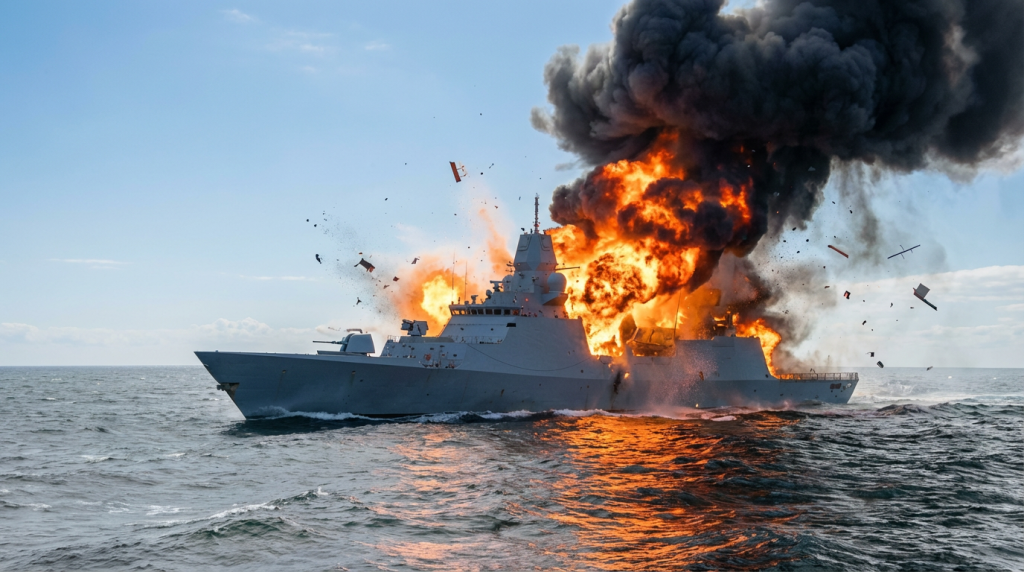
Modern naval conflicts increasingly involve asymmetric threats such as drones, unmanned surface vessels, and swarm attacks targeting large naval assets.
How can smaller forces challenge powerful navies? Can advanced fleets still dominate the seas in an era of autonomous systems and low-cost weapons?
The real story is not simply that smaller actors can now challenge advanced fleets. The balance of naval power is being rewritten by a new calculus. Agility, adaptability, and imagination are now as critical as tonnage and firepower. Low-cost, high-impact technologies are leveling the playing field. These advances are forcing even the most powerful navies to rethink their assumptions about control and dominance at sea.
From Traditional Naval Warfare to Distributed Maritime Threats
Historically, naval warfare revolved around symmetrical engagements between comparable forces. Battleships, submarines, and aircraft carriers operated as part of large fleets designed to control sea lanes and project power.
Although naval technology has evolved from cannons to precision missiles, and from diesel submarines to nuclear-powered fleets, the core concept remained largely unchanged. Dominance is still achieved through superior platforms and firepower.
However, the modern maritime domain is becoming far more complex.
Today’s threats move in distributed networks, operate at high speed, and evade traditional detection. Adversaries subvert the traditional model, where capital ships dictate outcomes by investing in asymmetric capabilities. These capabilities exploit the gaps between legacy systems, procurement cycles, and decision-making speeds. The most disruptive actors are those who harness innovation cycles that outpace the bureaucracies of established navies.
What Is Asymmetric Naval Warfare?
Asymmetric naval warfare refers to maritime combat strategies in which a weaker force uses unconventional tactics, low-cost technologies, or autonomous systems to challenge the superiority of larger naval powers. These methods often include unmanned surface vehicles, maritime drones, swarm attacks, mines, and electronic warfare designed to exploit vulnerabilities in traditional fleets.
Asymmetric naval warfare occurs when a weaker actor uses unconventional methods to offset the technological or numerical superiority of a stronger naval force.
These tactics focus on exploiting vulnerabilities, exposing the hidden dependencies and vulnerabilities of even the most sophisticated fleets rather than attempting to match their strength directly.
Examples include:
- Unmanned surface vehicles (USVs)
- Naval mines and improvised explosive vessels
- Underwater sabotage and diver delivery systems
- Fast attack craft operating in swarms
- Coastal missile batteries targeting large vessels
- Electronic warfare and remote control systems
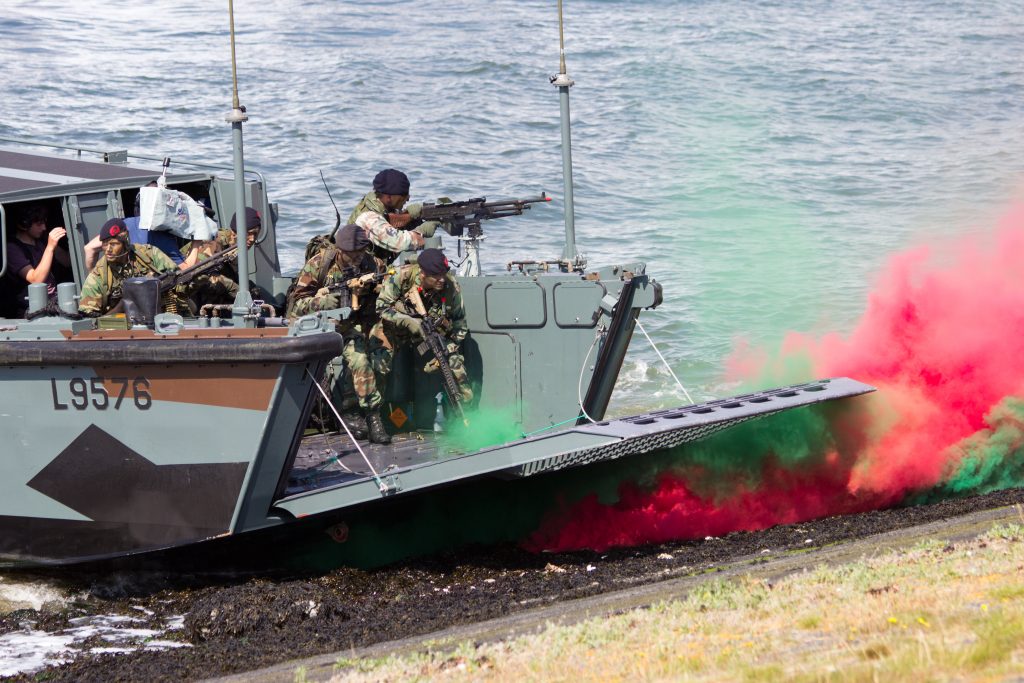
What makes these threats particularly dangerous isn’t just their cost asymmetry, but their ability to create strategic ambiguity. Unclear attribution and blurred escalation thresholds place navies in a constant state of operational uncertainty. This challenges traditional doctrines of deterrence and response.
A relatively inexpensive unmanned vessel carrying explosives can pose a serious threat to ships worth hundreds of millions, or even billions, of dollars.
Lessons From Modern Maritime Conflicts
Recent conflicts have demonstrated how rapidly asymmetric maritime capabilities are evolving.
The war in Ukraine provides one of the clearest examples, where unmanned surface vessels struck Russian naval assets in and around the Black Sea. These remotely operated systems did more than challenge major naval forces. Instead, they signaled a paradigm shift: the democratisation of maritime strike capabilities. In this new era, innovation can sometimes outpace industrial scale.
Across multiple regions, states and non-state actors are adopting similar tactics in contested maritime zones and heavily militarized maritime environments.
The Persian Gulf, the Red Sea, and the Indo-Pacific have increasingly become environments where naval drone threats and maritime asymmetric warfare tactics are shaping military planning. Fast attack boats, explosive unmanned vessels, and autonomous maritime platforms are forcing naval planners to rethink traditional maritime defense strategies.
Autonomous Systems and the Future of Asymmetric Naval Warfare
Technological advances are accelerating the shift toward asymmetric maritime operations has enabled the simultaneous operation of large numbers of unmanned platforms, including coordinated drone swarms.
Improvements in:
- Satellite communications
- Autonomous navigation
- Secure data links
- Artificial intelligence
- Sensor fusion
Fifteen years ago, unmanned maritime systems required line-of-sight control. Today, operators can control vessels from hundreds or even thousands of kilometers away, enabling distributed maritime attacks in which multiple unmanned systems overwhelm defensive sensors and response capabilities.
As a result, asymmetric naval warfare is no longer the domain of weaker actors alone; it has become an increasingly central component of modern naval strategy.
How Modern Navies Are Adapting to Asymmetric Naval Warfare
Asymmetric capabilities are no longer viewed only as tools of weaker actors. In fact, true maritime advantage increasingly belongs to those who can blend the legacy strengths of traditional fleets with the disruptive edge of autonomous systems, data-driven tactics, and rapid adaptation. The navies that will lead in the coming decades are those that treat innovation not as a procurement line item, but as a core operational ethos.
In fact, true maritime advantage increasingly belongs to those who can blend the legacy strengths of traditional fleets with the disruptive edge of autonomous systems, data-driven tactics, and rapid adaptation.
The navies that will lead in the coming decades are those that treat innovation not as a procurement line item, but as a core operational ethos.
Increasingly, major naval powers are incorporating asymmetric and autonomous capabilities into their own force structures.
Autonomous systems can complement traditional fleets by:
- Extending surveillance coverage
- Protecting critical maritime infrastructure
- Conducting high-risk missions without risking crews
- Creating deception and saturation tactics
- Enhancing coastal defense
Victory in the future maritime battlespace will depend not on mass alone, but on the ability to orchestrate diverse assets. These include manned and unmanned, physical and digital, all working in adaptive, resilient networks. This is less an arms race than a race for cognitive and organisational agility.
Protecting Maritime Infrastructure from Asymmetric Threats
For governments, naval forces, and critical infrastructure operators, the key takeaway is clear:
The maritime threat environment is evolving rapidly.
Across the maritime domain, small, agile, and difficult-to-detect threats increasingly target ports, offshore energy platforms, shipping routes, naval bases, and coastal infrastructure.
Effective maritime security therefore requires:
- Persistent maritime surveillance
- Multi-sensor detection systems
- Rapid identification and verification of small surface threats
- Integrated command and control
- Layered response capabilities
Advanced Multi-Layered Sensor Surveillance Systems
Modern maritime defense architectures increasingly rely on the integration of advanced multi-sensor surveillance systems capable of detecting small, low-profile maritime threats at extended ranges. When security forces identify a potential threat, they must rapidly verify, track, and respond using counter-drone and electronic mitigation technologies designed to neutralize autonomous systems before they reach critical infrastructure.
This layered approach- detection, verification, tracking, and mitigation is becoming essential for protecting ports, naval bases, offshore energy platforms, and strategic maritime routes from emerging asymmetric threats. Achieving this requires integrating detection, verification, and response into a unified system capable of identifying threats early and neutralizing them before they reach critical assets.
As a result, detection, verification, and response must increasingly function within a unified system capable of identifying emerging threats early and neutralizing them before they reach critical assets.
The shift toward asymmetric naval warfare does not replace traditional naval power, it fundamentally reshapes how maritime security is planned and executed.
As autonomous technologies continue to advance, the defining question for maritime security is not merely technological, but conceptual: can navies adapt their doctrine, culture, and command structures quickly enough to keep pace with the changing character of conflict at sea?
Can navies adapt their doctrine, culture, and command structures quickly enough to keep pace with the changing character of conflict at sea?